
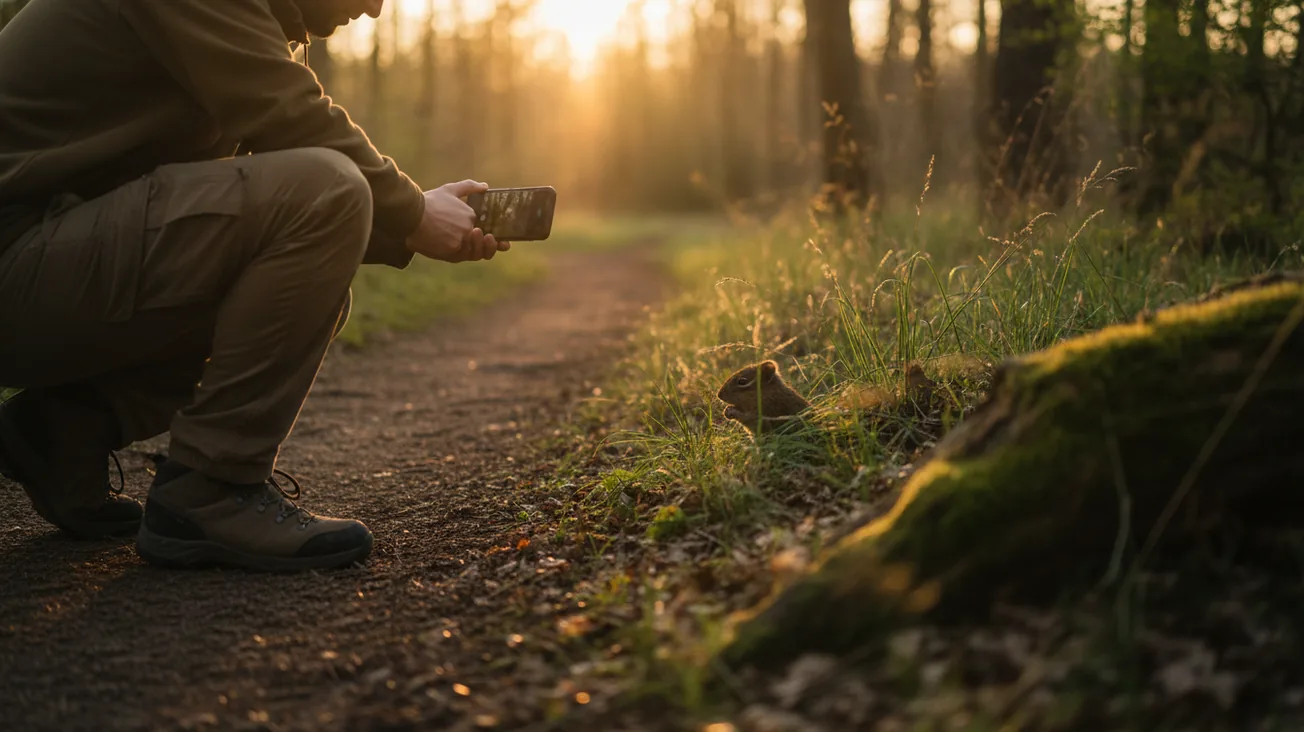
Features to check first on an unknown animal
Skip color at the start. It shifts with lighting, age, sex, season, wetness and camera processing. Shape and structure stay put, so begin there.
- Body shape and size. Compare overall proportions, estimated length, body depth, leg length and posture.
- Head. Look at snout shape, eye position, ear shape, horns or antlers, bill, teeth and facial markings. On reptiles, head scales can matter too.
- Appendages. Count legs, wings, toes, claws, antennae, fins and tail segments.
- Surface pattern. Note spots, stripes, bands, scales, feathers or fur texture, and exactly where each one sits on the body.
The angle of the photo matters as much as the animal. A whole-body side view works well for mammals. A flat side view suits fish, and a view from above shows insect wings and body segments. If your subject is swimming, our page on working out what fish you caught covers that case.
Photographing an animal so the species can be pinned down
One blurry shot rarely settles anything. Take several images that show the whole animal, the head, the side profile, the limbs or wings, the tail and something for scale. Save the original file as is and do your cropping on copies.
For scale, use a known object that is already nearby. Never place anything next to the animal, and never step closer for a better angle. Do not approach, handle, feed or disturb wildlife for the sake of a picture. A distant, heavily cropped or filtered photo throws away the details that separate lookalikes, so zoom with your camera from a safe distance instead.
How location, habitat and behavior narrow the list
Two animals can look nearly the same and live in different places. Water type, vegetation, buildings, elevation, country or region and season can all rule out species. Big News Network's guide to identifying wildlife from a photo makes the same point, and it is the step people skip most.
Behavior breaks ties too. Flight pattern, swimming style, gait, feeding, calls and time of activity all help. If you saw something hopping along a wet ditch at dusk, write that down along with the date, place, weather and habitat. Those notes are often worth more than a third photo.
Why lookalikes fool people
- Juveniles and adults. Young animals can have different proportions, markings or plumage.
- Males and females. Sexes of one species can differ a lot in size and coloring.
- Related species. Compare bill or snout shape, tail length, leg placement, scale arrangement, wing pattern and geographic range.
- Domestic and wild relatives. A collar, ear tag, body condition, coat pattern and behavior help, but a photo may not settle it.
- Objects. Leaves, branches, debris, shadows, toys and decorations can pass for animals in a quick glance, and if a branch is what fooled you, our guide to identifying a tree can help, while a blossom mistaken for a creature is covered in our guide to identifying unknown flowers, and a odd fungus mistaken for one is covered in our guide to identifying wild mushrooms.
Pets deserve their own treatment. For a dog, try our guide to finding out your dog's breed, and for a cat, the page on telling cat types apart. If your real question is about a mark on your skin rather than the creature that made it, see how to identify bug bites by picture.
Animal identifier apps compared
No single animal identifier covers every creature. Each tool below does one job well, and they work best together.
| Tool | Best for | What to know |
|---|---|---|
| Seek by iNaturalist | Quick casual suggestions | Uses image recognition to suggest plants and animals and can scan organisms through its camera. Everyday use does not require an account, according to its listed guidance. |
| iNaturalist | Community review | Accepts photo observations and lets people discuss and identify them. Submitted observations can contribute to citizen-science research. |
| Merlin Bird ID | Birds only | Identifies birds from photographs and calls. Some functions may need regional data packs. |
| Google Lens | Broad visual search | Returns visually related images and web results. It is not wildlife-specific and can produce random suggestions. |
| ObsIdentify | Plants, animals and fungi | Suggests an identification for wild species and recommends confirming it against visible characteristics. |
The catch with general visual-search tools is that they return similar images, not a confirmed species. A pretty match is not proof.
A photo-to-name routine for any animal
- Save the original image and note the date, location, habitat, weather and behavior.
- Crop copies that show the whole animal, head, side profile, underside or back, limbs or wings, and tail.
- Estimate size using an object already in the frame.
- Describe the anatomy in plain terms before you look at any suggestion.
- Run the photo through one or two tools. Our scanner will describe what it sees and give a confidence level, and Merlin is the pick for birds.
- Write down every plausible candidate, not only the top-ranked one.
- Compare each candidate with a regional field guide or a museum or university species database. Check range, habitat, season, size and diagnostic features.
- If two or more candidates survive, ask a local expert or post to an identification community.
- Report protected, invasive, injured or dangerous wildlife to the relevant authority instead of handling it.
When to call a wildlife authority instead of naming the animal
Some animals should be left alone, whatever they turn out to be. That includes large mammals, predators, venomous animals, nesting animals and any animal that looks ill. Do not feed, bait, trap, restrain or relocate an unidentified wild animal.
Wildlife rehabilitators, naturalists, park authorities and government wildlife agencies are the right contacts when an animal is injured, dangerous, protected or invasive. Colorado Parks and Wildlife, for example, states that certain personal information, private-property information and animal-location data can receive legal protection in sighting reports.
Privacy cuts both ways. Do not publish exact locations of threatened species, nests or dens unless an authority recommends it. Check app privacy settings before uploading, since photos can carry faces, addresses, license plates, metadata and private property. Local rules on collecting specimens, using traps or entering private land vary by place and species, so check yours.
Common errors that end in the wrong species name
- Treating an AI result as confirmation.
- Ignoring geographic range and habitat.
- Identifying by color alone.
- Forgetting that juveniles, adults, males and females can look different.
- Leaving the head, tail, wings, feet or scale out of the photo.
- Mixing up a similar species with a broad common name.
If the evidence stops at a family or genus, stop there too. "Unknown" is an honest answer. And if the thing in your picture turns out not to be an animal at all, you can find out what an unfamiliar thing is from a photo on our homepage.
Questions about what animal is this
Can you identify an animal from a photo?
Often you can get a good lead, but a photo alone cannot identify an unspecified animal with certainty. You need the animal's anatomy, size, habitat, location, season and behavior too. Treat any app result as a candidate, then verify it with a regional field guide, a species database or a local expert before you call it confirmed.
What features should I photograph to identify an animal?
Capture the whole animal, the head, a side profile, the limbs or wings, the tail and something for scale. Count legs, toes, claws, antennae or fins, and note markings and their placement. Take the shots from a safe distance without disturbing the animal, and keep the original file so you can crop copies.
What is the best app to identify an animal?
That changes with what you saw. Seek gives fast, casual suggestions through your camera. iNaturalist adds community review and species records. Merlin Bird ID specializes in birds and works from photos and calls. ObsIdentify covers wild plants, animals and fungi. Using two of them and comparing results beats trusting one.
Does Google Lens identify animals?
Google Lens runs a broad visual search from a camera image or saved photo and returns visually related images and web results. It is not wildlife-specific, so it can return similar-looking pictures or random suggestions instead of a confirmed species. Use it as a starting point, then check the candidates against a field guide.
How do I identify a bird from a photo?
Merlin Bird ID is built for birds and can identify them from photographs and calls, though some functions may need regional data packs. Note bill shape, tail length, wing pattern, leg placement and where you saw the bird. Compare the suggestions with a regional guide, since similar species often overlap in color.
Why does color not work well for identifying animals?
Color changes with lighting, age, sex, season, wetness and camera processing. A young animal may look different from an adult, and males and females of one species can differ a lot. Body shape, proportions, pattern placement, head features and geographic range are more reliable clues than the shade you see on screen.
What should I do if I find an injured or dangerous animal?
Do not approach, touch, feed, trap or relocate it. Take photos from a distance and contact a wildlife rehabilitator, park authority or your government wildlife agency. Report protected, invasive, injured or dangerous animals to them, and follow their instructions on what to do next.
Why do lookalike animals fool people?
Several things cause mix-ups. Juveniles can have different proportions, markings or plumage than adults, and males and females of one species can differ a lot in size and coloring. Related species look alike, so compare bill or snout shape, tail length, leg placement, scale arrangement, wing pattern and geographic range. Leaves, branches, shadows and toys can also pass for animals at a quick glance.