
The clues that identify a handbag fastest
A bag gives you more evidence than most objects. Check these details in roughly this order, because the first few often settle it.
| Clue | What to note |
|---|---|
| Logo or monogram | Interlocking letters, a repeating pattern, or a metal plaque |
| Heat stamp or interior label | Brand name, date code, serial number, and any Made in text |
| Silhouette | Flap, tote, bucket, satchel, hobo, shoulder, crossbody, clutch, or backpack |
| Closure | Zipper, turn-lock, magnetic snap, drawstring, or clasp |
| Hardware | Color, shape, engravings, chain-link pattern, feet, zipper pulls, logo plates |
| Material and texture | Smooth or grained leather, suede, canvas, nylon, patent, woven, or synthetic |
| Handles and straps | Number, attachment style, length, adjustability, padding, chain or leather |
| Dimensions | Length, height, depth, and strap drop |
Reading logos, monograms and plaques
Brand marks are the shortcut. The Lens App guide to bags gives familiar examples, including Chanel's interlocking CC, Gucci's interlocking GG, the Louis Vuitton monogram, Coach's C pattern, and Prada's triangle plaque. If you can see a mark but cannot read or place it, our page on identifying a logo from a photo covers that step on its own.
Do not stop at the outside. The heat stamp or label inside is where the brand name, a date code, a serial number, or Made in text usually sits. Photograph it straight on, in good light, before you do anything else. When the bag has no visible mark at all, the question becomes a general one, and our guide to working out which brand made something explains how to approach it.
Shots a bag identifier needs from you
Most failed searches come from one blurry, angled photo. Any bag identifier, human or AI, does better with a set of clear shots.
- Shoot the front, back, sides, base, and interior.
- Take close-ups of the label, logo, hardware, and closure.
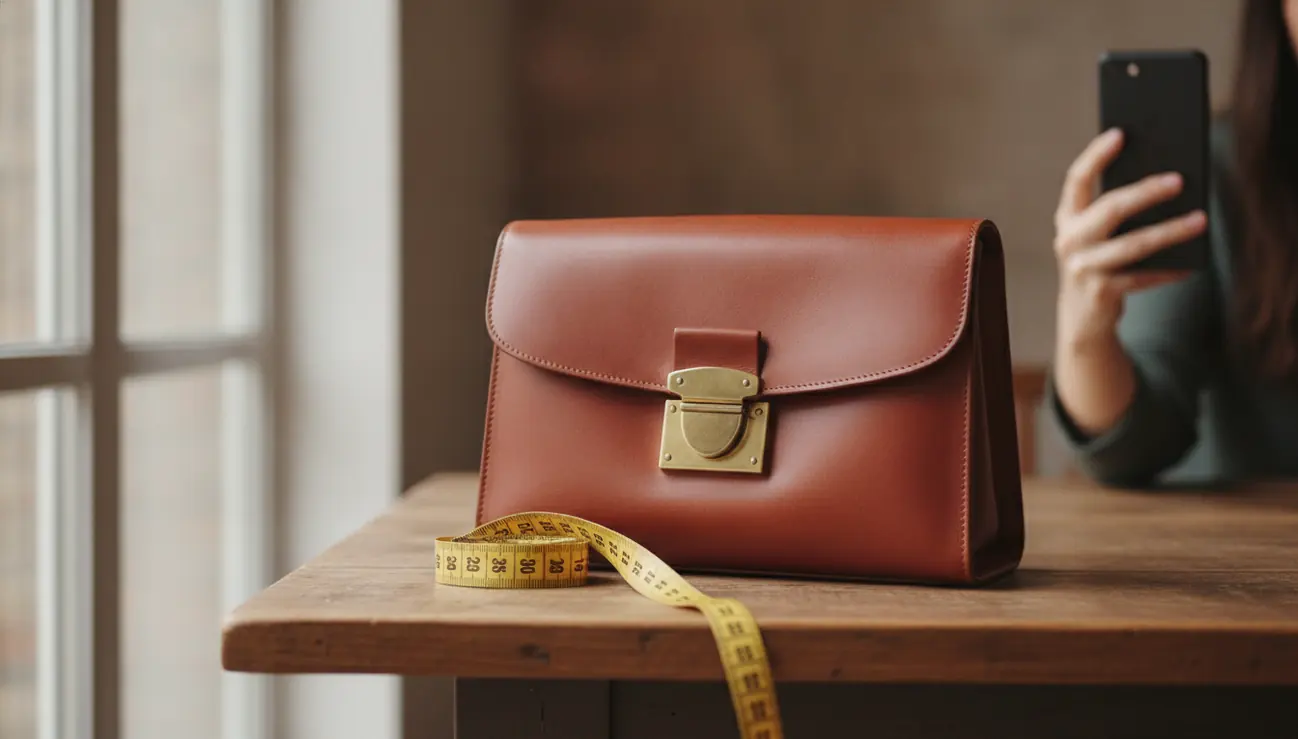
- Lay a ruler or tape measure next to the bag in one photo.
- Write down length, height, depth, handle drop, and strap length.
- Note the material, color, and any visible text.
- Crop in on the logo, engraving, or pattern that stands out.
- Drop your sharpest shot into the drop zone at the page top for a read on brand and style.
- Check that guess against more than one other source before you trust it.
Why size and shape alone can mislead you
The same model often comes in several sizes, so two bags that look identical may be different products. Lens App points out that visually similar models can differ mainly by size. Measure the bag instead of trusting your eye.
Shape is just as slippery. A bag that resembles a Birkin, a Speedy, or a Chanel flap does not prove the brand or the model. Plenty of makers copy a silhouette without copying anything else. Look at construction too, meaning stitch spacing, edge paint, lining, piping, pockets, and the shape of the base. Those details separate a true match from a lookalike.
Naming a bag from a photo is easy, but proving it is real is not
Naming a likely model is one job. Proving the bag is genuine is another, and a photo only does the first. A visual match can point to a design family, but it will not give you the production year. For that you need a label, a code, a receipt, or the brand's own records.
Fashion Times lists reported warning signs of a fake, including inconsistent stitching, lightweight or hollow hardware, a chemical odor, and serial numbers that do not add up. None of these proves anything alone. A low-confidence AI result is not a reason to accuse a seller of anything. Counterfeit laws also differ by country, and in some places knowingly buying a fake can carry legal risk for the buyer.
If money, insurance, or a dispute is involved, hire a professional authenticator. Ask who the expert is, what method they use, and get the terms in writing. Keep receipts, listing screenshots, and your photos.
Using Google Lens and other tools together
Google says Lens can return prices, deals, reviews, and retailers for products it recognizes from an uploaded or captured image. Run your clearest photo through it and compare several visual matches, not just the first.
Handbag-specific AI tools go further on paper. Raugen's guide describes tools that advertise brand, model, material, hardware, dimensions, color, era, and estimated value from photos. One valuation app accepts up to 5 photos for each bag. Treat all of it as a lead. Use at least two independent sources, and compare against the brand's own product images and dated resale listings. A boutique or customer service team may confirm design details, though policies differ and they may not authenticate from photos.
Finding out what a bag is worth after you name it
A name is not a price. Resale value depends on brand, model, size, material, color, condition, whether the dustbag and box are included, the market, and the date. How to think about that is covered in valuing an item.
Two rules save the most disappointment. Compare against completed sales, not asking prices. And do not treat today's retail price as resale value. For scale only, Raugen describes affordable fashion handbags as running from under $20 to about $100, which is a broad category range and says nothing about a specific bag.
Privacy slips to avoid when you share bag photos
Bag photos leak more than you expect. Do not post visible serial numbers, receipts, addresses, faces, payment details, or shipping labels. Read an app's privacy policy before uploading, since retention, training use, deletion, and sharing terms vary. When you buy, use secure payment and read the return and authentication policies first.
Common mistakes when identifying a bag
- Relying on one blurred or angled photo.
- Cropping out the label, interior, hardware, or base.
- Confusing a style category with an exact model.
- Ignoring size differences between versions.
- Treating a logo or serial number as proof the bag is real.
- Trusting a single AI result without checking brand images.
- Assuming a discontinued bag is worthless, or that a popular design must be genuine.
The same habits of clear photos, close-ups, and a second opinion work for other fashion finds, such as figuring out which shoes you are looking at or tracking down the maker of a watch. Any other object you cannot name responds to the same photo method on the homepage.
Questions about what bag is this
How can I identify a bag from a photo?
Photograph the front, back, sides, base, interior, label, logo, hardware, and closure, with a ruler in one shot. Read the logo and interior stamp first, then note the silhouette, material, and size. Run the clearest image through a visual search tool, compare several matches, and confirm against the brand's own images and dated resale listings before you call it a match.
Where do I find the brand name on a handbag?
Check the heat stamp or label inside the bag, which usually carries the brand name, and sometimes a date code, serial number, or Made in text. Also look at hardware plaques, zipper pulls, and engravings on clasps. Photograph each one straight on in good light. Many bags show a monogram or logo pattern on the outside as well.
Can an app tell me if my bag is real?
No photo-based tool can authenticate a bag. An app may suggest a likely brand and model, but that is identification, not proof. Reported warning signs of fakes include inconsistent stitching, hollow hardware, chemical odor, and serial-number problems, and none proves a fake alone. For a purchase, sale, or insurance claim, use a professional authenticator and get the findings in writing.
Does Google Lens identify handbags?
Google says Lens can return prices, deals, reviews, and retailers for products it recognizes from an uploaded or captured image. That makes it useful for bags that are sold new. Compare several visual matches instead of trusting the first, and check dimensions and details against the brand's product page, since lookalike bags are common.
How do I find the model of a bag with no logo?
Describe it in words and measurements. Note the silhouette, closure, hardware shape and color, material, handle style, and exact size. Search the suspected brand plus those details, then compare against brand images and dated resale listings. A shape that resembles a famous model does not prove the brand, so look for matching construction details too.
How can I tell what year my bag was made?
A photo of the outside rarely shows it. A visual match can identify a design family, but the production year usually needs a label, a date code, a receipt, or the brand's own records. Photograph the interior label and any code clearly, and keep any paperwork that came with the bag.
How many photos should I take of a bag?
Take at least nine views if you can. Cover the front, back, side, base, interior, label, logo, hardware, and closure, plus one with a ruler beside the bag. Some tools accept fewer, and one valuation app takes up to 5 photos, so pick the clearest images and crop in on the logo or label.
Can I get my bag's resale value from a photo?
Identify the brand, model, and size first, then look at completed sales rather than asking prices. Value depends on condition, material, color, whether it is complete with box or dustbag, the market, and the date. Current retail price is not resale value. For high-value items, get professional authentication before relying on any estimate.