
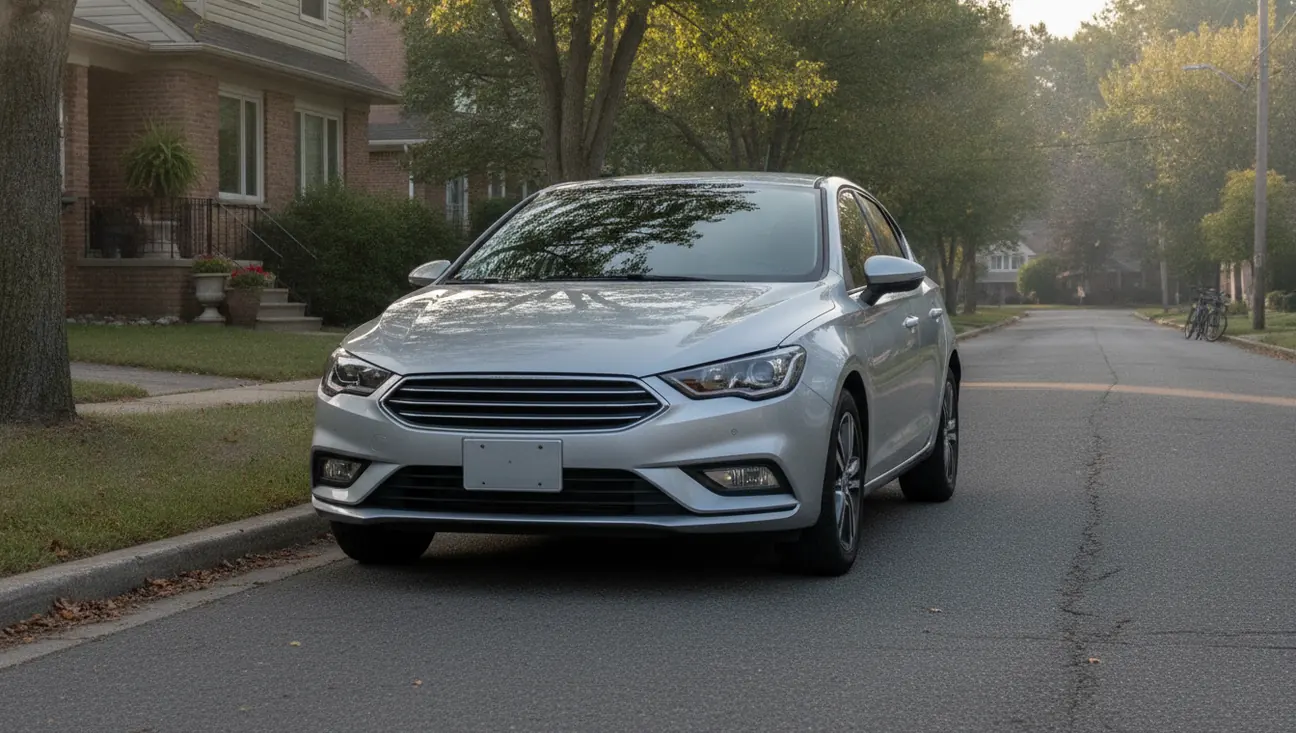
The details that give a car away in a photo
Color and size tell you almost nothing. Plenty of unrelated cars come in the same gray. What works is the face and the outline.
Start with the front or rear fascia. Grille shape, headlamp and taillamp design, and bumper openings are the quickest fingerprints. Many cars have a lighting signature you can recognize at night before you ever see a badge.
- Body style. Sedan, hatchback, wagon, coupe, convertible, pickup, minivan, SUV or crossover. This cuts the candidate list fast.
- Doors, windows and mirrors. Count the doors, then look at the shape of the rear-quarter window, which differs a lot between related models.
- Wheel design, tire proportions and ride height. Useful, but wheels are easy to swap, so use them last.
- Hood shape and shoulder line. The crease running along the side of the body is hard to fake.
- Small hardware. Exhaust outlets, roof rails, fog lamps, cameras, sensors and a charging port all narrow things down.
- Badges and trim lettering. These name the make, and sometimes the model and trim. If you spot an unfamiliar emblem, our guide to identifying unknown symbols may help.
When a badge is your only clue, reading a logo from a photo shows how to decode it. If the badge is the only thing you know, start with figuring out who made something.
A license plate can hint at the country or region. It never proves the model.
Taking car photos that let a model be identified
When you ask what car is this, the quality of the photo decides most of the answer. A blurry shot from 100 feet away gives you a silhouette and a guess. A sharp shot of the front corner gives you a name.
- Use the highest-resolution original, not a screenshot or a forwarded copy.
- Crop to the car, but keep the badges, lamps, grille, wheels and full body profile in frame.
- Take the front, rear, side profile and wheels as separate photos. Add the interior and any readable lettering if you can.
- Write down the country, the body style, the apparent age of the car and the plate format.
Stay on the sidewalk while you do it. Never step into a road or traffic lane for a better angle.
Using the scanner and other tools for a first guess
Upload your photo to the scanner above and it describes what it sees, names a likely make and model, and gives a confidence level. Check that name against the registration or the maker's own site before relying on it. It works like a car identifier by picture, and like any of them it does better with a clear front or side view.
Google Lens and similar visual search services work from image matching instead. It compares your image with visually similar indexed images, so results depend on image quality and on how well its database covers your car. Either way, you end up with candidates.
Then do the real work. Compare each candidate with manufacturer images for the right generation and body style. Check distinctive details, such as lamp shape and window outline, instead of leaning on color, wheels or add-on parts. If you also spot something odd on the car and want to know what it is, the photo tool on the homepage handles more than vehicles.
Separating lookalike cars from each other
Most wrong answers come from cars that share a family face. This table shows what to compare in each case.
| Situation | What to compare |
|---|---|
| Variants of the same generation | Grille, lamps, bumpers, wheels, badges and exhaust layout |
| Related models from one manufacturer | Window shape, rear-quarter glass, dashboard, wheelbase and body length |
| Facelift versus earlier model | Headlamp internals, grille pattern, bumper openings, taillamp graphics and badge placement |
| Badge-engineered twins | Manufacturer emblems, steering wheel, instrument cluster, door panels and VIN decoding |
| SUV versus crossover | Chassis, roofline, ground clearance, rear overhang and visible underbody construction |
| Factory trim versus aftermarket | Wheels, spoilers, grilles, wraps, lights and badges, all of which owners can replace |
A facelift updates details like headlamps, grille and bumper on an existing car. It is not a new generation. If the roofline, doors and glass outline match but the lamps differ, you are probably looking at a facelift.
The SUV versus crossover row is the hardest. One photo may not be enough, because the difference lives in the chassis and the underbody.
Confirming the car with its VIN
A photo gives you a probable answer. The vehicle identification number gives you a confirmed one. According to NHTSA, a VIN has 17 characters for U.S. passenger cars, multipurpose passenger vehicles and most trucks, and it identifies one specific vehicle.
NHTSA also explains what is packed into those characters. The VIN carries manufacturer information, vehicle-specific data, a check digit, the model year, the plant location and a sequence number.
For many U.S. vehicles, you can read the public VIN through the windshield near the left windshield pillar. It may also appear on the driver-side doorjamb, and it is printed on registration and insurance documents. Only photograph it if the car is yours or you have permission to inspect it.
Then decode it. NHTSA's vPIC decoder returns manufacturer-reported basic vehicle information, plus plant and country data. Enter all 17 characters, and copy them carefully. A partial or mistyped VIN sends you to the wrong car, or to nothing.
Compare the decoded result with your photo. If they agree, you can call the identification confirmed. NHTSA's recall page also lets you search by VIN or, for some searches, by license plate number, which tells you whether a safety recall applies. A recall notice flags a potential repair. It does not replace a mechanic's inspection.
Easy ways to end up with the wrong car
- Guessing from color, body size or an emblem alone.
- Confusing a facelift with a new generation.
- Treating aftermarket badges, wheels, lights or body kits as factory features.
- Assuming a similar-looking car has the same engine, trim or drivetrain.
- Ignoring regional differences in grilles, lamps, bumpers, plates and model names.
- Treating a visual-search match as proof.
Where a photo settles the question and where an expert is needed
A photo usually supports a probable make and model. Exact trim, engine, drivetrain and model year from appearance alone need backup. So label your result as confirmed, probable or unknown, and do not present a visual guess as a confirmed identification.
For the backup, manufacturer databases and owner manuals confirm equipment, trim names and dimensions for a specific model year. Parts catalogs use the VIN or vehicle configuration to separate compatible years and trims. Licensed appraisers, marque specialists, dealerships and mechanics can inspect hidden identifiers, factory equipment, modifications and condition in person.
Price questions only make sense once you know the exact make, model and year. After that, our page on figuring out what something is worth is a sensible next stop. And if the thing you photographed is a component rather than the whole vehicle, try identifying an unknown car part.
Privacy and etiquette when you photograph a car
A VIN is vehicle-identifying information, and it can count as personal information when linked to an owner. NHTSA material on VIN data makes that point, so avoid publishing one without a reason.
- Blur license plates, faces, addresses and documents before you post a photo.
- Do not open, move, touch or dismantle a vehicle without permission.
- Do not enter private property to get a better shot.
- Do not use identification tools to stalk, harass, impersonate, steal or target anyone.
Remember what a VIN lookup does not prove. It does not by itself establish ownership, title status, mileage accuracy or current condition.
Questions about what car is this
Can you identify a car from a picture?
Usually you can get a probable make and model from a clear photo, using the badge, grille, lamps, body style and wheels. A photo cannot reliably prove the exact vehicle. Trim, engine, drivetrain and model year need extra evidence, and the VIN is the strongest evidence. Treat any photo-based result as probable until you check it.
What details help identify a car the most?
The manufacturer badge, grille, headlamps, taillamps and the front or rear fascia help most. Next come body style, door count, rear-quarter window shape, wheel design, hood shape and the shoulder line. Small hardware such as exhaust outlets, roof rails, fog lamps, sensors and charging ports can separate close lookalikes. Color alone tells you very little.
Can a VIN tell me exactly what car I have?
Read all 17 characters from the windshield near the left pillar, the driver-side doorjamb, or a registration or insurance document. Enter the complete VIN into NHTSA's vPIC decoder. It returns manufacturer-reported basic vehicle information plus plant and country data. A partial or mistyped VIN will give wrong or empty results, so copy it carefully.
Where is the VIN on a car?
For many U.S. vehicles, the public VIN is readable through the windshield near the left windshield pillar, on the driver's side. It may also appear on the driver-side doorjamb. You can find it printed on registration and insurance paperwork as well. Only photograph it if the car is yours or you have permission.
Can you identify a car from its license plate?
A plate's shape and position can hint at the country or region, but they do not prove the model. NHTSA's recall lookup does accept a license plate number for some searches, which can tell you whether a safety recall applies. For a reliable identification of the vehicle itself, use the full VIN.
How do I tell a facelift from a new generation?
A facelift updates details on an existing car, such as headlamp internals, grille pattern, bumper openings, taillamp graphics and badge placement. A new generation changes the whole design. If the roofline, doors and glass outline match but the lamps and grille differ, you are likely looking at a facelift of the earlier model.
Why does a search result not match my car?
Visual-search tools compare your image with visually similar indexed images, so results depend on photo quality and database coverage. They give candidates, not proof. Check each one against manufacturer images for the right generation and body style, then confirm with the VIN when you can. Label the result confirmed, probable or unknown.
Can aftermarket parts make a car hard to identify?
Yes. Wheels, spoilers, grilles, wraps, lights and badges can all be replaced, so they may not reflect what the factory built. Focus on features owners rarely change, such as the roofline, window shapes, door layout and overall body profile. Treat unusual trim or lettering as possibly added later until the VIN says otherwise.