
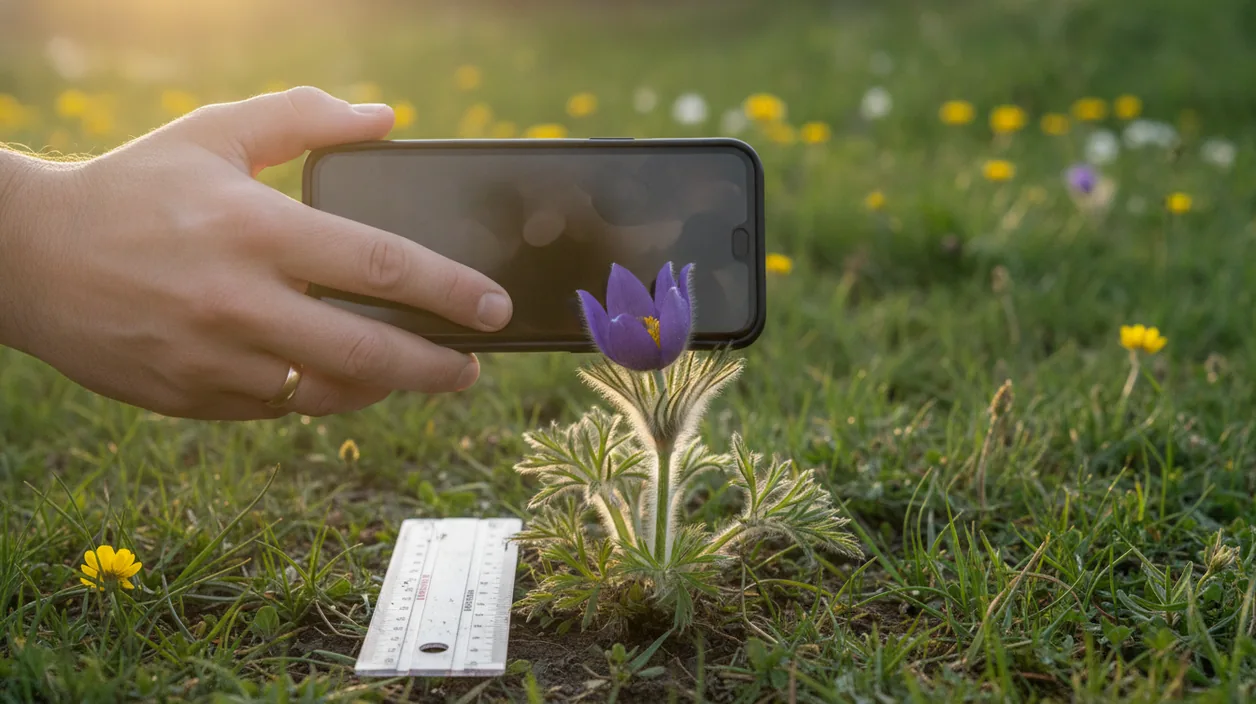
Photos to take when you ask what flower is this
The usual photo is one close-up of the bloom. It is also the weakest photo you can send. According to floweridentifier.org, a reliable identification normally needs the bloom, leaves, stem, plant habit, season, habitat and geographic location. So take a small set of shots instead of one.
- The whole plant from several feet away, so its habit shows.
- One flower, straight on.
- The same flower from the side.
- The underside of the flower and the spot where it joins the stem.
- The upper and lower surfaces of a leaf.
- The stem, with any branching, thorns, hairs, sap, fruit or seed pods.
- A ruler, coin or other object of known size next to the plant for scale.
- A quick note of the country, region, habitat, date, rough elevation, and whether the plant was wild or planted.
Skip the filters and tap the screen to focus on the part you want sharp. Blurry, dark, overexposed or heavily filtered images wipe out the details a flower identifier needs, like hairs on a stem or the way a leaf attaches. If the bloom sits in shade, step aside so your own shadow does not cover it.
Flower features that separate one species from another
Botanists read a flower like a checklist. Each item narrows the field, and the more of them you can report, the fewer candidates survive.
- Bloom structure. The number and arrangement of petals, sepals, rays, florets, lips, spurs, tubes or bracts.
- Flower center. A disk, a cone, stamens, a stigma, anthers, and whether the center is open or enclosed.
- Leaves. Simple or compound, opposite or alternate, smooth or lobed edges, veins, texture, and how the leaf attaches to the stem.
- Stem. Round or angular, hairy or smooth, thorns, branching, sap, and whether it is hollow.
- Plant habit. Herb, shrub, vine, tree, rosette, clump or groundcover.
- Orientation. Upright or nodding, clustered or solitary, spike-like or head-like.
- Context. Habitat, elevation, growing conditions, flowering season and region.
Leaf and stem traits are the ones people skip, and they can settle a tie. Two flowers can look alike from the front and still differ in how the leaves sit on the stem.
Why flower color alone gets you the wrong plant
Color feels like the obvious clue, so it is the first thing people type into a search box. It is also the weakest one. Yellow, white and purple flowers turn up in many unrelated plant groups, and floweridentifier.org lists color alone as insufficient.
Garden plants add another wrinkle. Cultivated varieties may have altered petal counts, colors or shapes, so a nursery flower can look unlike the wild species it came from. A single photo of a cultivar may support a guess at the genus and little more. Tell whatever tool you use whether the plant was wild or planted. That context changes what a good answer looks like.
Flowers that get mixed up, and what to check
Some pairs and groups fool people again and again. In each case the fix is to look at a feature the lookalikes do not share.
| Lookalike group | What to inspect |
|---|---|
| Daisy-like flowers | Whether you are seeing true petals or many small ray florets. Then check the center, leaf shape and stem. |
| Lilies and daylilies | True lilies generally have bulbs and leaves arranged along the stem. Daylily flowers typically last about one day. |
| Buttercups and marsh marigolds | Petal number, how the leaves attach, the habitat, and the structure of the flower center. |
| Wild carrot, poison hemlock and other white umbellifers | Stem markings, how divided the leaves are, the flower clusters, odor and hairs. |
| Orchids and other flowers with two matching sides | The specialized lower petal, the pollen structures and any spur. |
A close visual match is only a candidate until some distinguishing feature separates it from its lookalikes. That is the rule floweridentifier.org puts at the center of its method, and it is a good one to keep in your pocket.
Flower identifier apps and what each one claims
A flower identifier app takes your photos and returns ranked guesses. The differences are in cost, in the database behind it and in how much human review sits behind the answer.
| Tool | What the sources say | Good for |
|---|---|---|
| PlantNet | Free. Beebom reports it recognizes more than 20,000 plant species. A 2026 comparison lists about 88% accuracy. | Several ranked results from a research-oriented plant database |
| iNaturalist | Free and community-supported, with automated suggestions. | Having other users review and confirm your observation |
| Seek | Free and beginner-oriented. It may work offline, and it sometimes names only a family or genus. | Quick checks in the field |
| PictureThis | A 2026 comparison lists about 95% accuracy and a premium price of $29.99 per year. | People who want a paid, polished app |
| PlantSnap | The same type of comparison reports more than 625,000 species across 200 countries. | Broad coverage claims |
| Google Lens | General visual search that can show reference matches. | A fast first look, not a botanical verdict |
Treat the numbers with care. The species counts and accuracy percentages come from vendors, Beebom and a comparison site, not from a test on your photo. Apps change their prices and features, so read the current terms before paying. A 95% beside an 88% does not mean one app will beat the other on your flower.
Reading app suggestions without fooling yourself
Upload the whole group to PlantNet, iNaturalist or Seek, or to the upload form up top, where the AI returns a likely name and how strong the match looks. Then slow down. The first suggestion is a lead, not a result.
- Compare at least three suggested results.
- Look at scientific names, not common names alone. One common name can point to several species.
- Pick one feature that separates your top two candidates, such as the leaf attachment or the spur, and check it on your plant.
- Remember that a high confidence score is not certainty.
- If the evidence supports only a family or genus, say that. Forcing a species name onto a thin photo is how wrong labels spread.
Seek does the last one on its own, sometimes stopping at family or genus when the image is not enough. That is honest behavior, and you can copy it.
Where to confirm a flower identification
Regional floras and herbarium databases hold authoritative photographs, distribution records, specimens, botanical descriptions and scientific names. The best one depends on where you live, so search for the flora of your state or country. University extension services, native-plant societies, botanical gardens and natural-history museums can also review a photo, and so can botanists and horticulturists. Hard species and poisonous lookalikes deserve a human look. iNaturalist builds that in, since other users can confirm or correct what you post.
Not a flower after all? The photo identifier on the homepage handles other objects. A tall woody plant is a job for identifying the tree, and anything growing from the ground without petals may belong on the page about identifying a mushroom. The insect on your bloom is a separate question, handled by the animal page. If it left a welt, see the bug bite page. A dog in your garden shots belongs to the dog breed page, a cat among the plants to the feline page, and a pond fish to the fish page. For objects with no name in your head, the what-is-this-called page is where to begin.
Safety rules before you taste, touch or pick a plant
Do not eat, touch or medicate anything because a photo match said it was safe. Do not eat, brew, burn or use a plant medicinally based only on an app identification. Poisonous plants can resemble edible ones. White umbellifers are the classic trap, since wild carrot and poison hemlock share a look, and the advice is simple. Do not taste any plant.
Avoid touching unknown sap, hairs, thorns or pollen, and wash your hands after handling a plant you cannot name. Get human confirmation before you eat anything, handle sap, treat a plant medicinally or remove a protected wild plant. Anyone who swallowed part of an unknown plant, or reacts after touching one, needs poison control or a doctor right away, and your photos should go with them.
Picking has rules too. Do not collect plants from protected areas, private property, roadsides or endangered-species habitats without permission.
Privacy and location in flower photos
Phone photos can carry GPS metadata. If privacy matters, remove the location data before you post a picture publicly. Public observations can also reveal where a rare plant grows, or where you were on a given day. How much an app exposes depends on its settings and your account settings, so check them. Keep identifiable people, private property and license plates out of the frame unless you have permission.
Where a flower identification goes astray
Most wrong answers come from a short list of habits. Going by color alone is the big one. Photographing only the bloom and leaving out the leaves, stem, underside and whole plant is next. After that come ignoring location, season, habitat and plant size, and treating the first suggestion as confirmed. People also mix up a common name with a unique species name, forget that a cultivar is not a wild species, and read a high confidence score as proof. The last mistake is the most serious. An app result is not evidence that a plant is edible or medicinal.
Questions about what flower is this
Can you identify a flower from a picture?
Often you can get a good suggestion, but a picture of the bloom alone is rarely enough. A reliable identification normally needs the flower, leaves, stem, whole-plant shape, season, habitat and location. Shoot several photos and compare at least three suggested results by scientific name. Hold the answer as a candidate until a distinguishing feature confirms it.
What is the best free app to identify flowers?
PlantNet, iNaturalist and Seek are all free. PlantNet gives several ranked suggestions from a research-oriented database. iNaturalist adds community review by other users. Seek is aimed at beginners and sometimes names only a family or genus when the photo is not enough. Try more than one and see where their answers agree.
How accurate are flower identification apps?
One 2026 comparison lists about 95% for PictureThis and about 88% for PlantNet, but those figures are not tests of your photo. Accuracy shifts with photo quality, the plant and your location. A high confidence score is not certainty, so check the result against a regional flora or a local expert.
Can Google Lens identify flowers?
Lens searches by image across everything, so it can pull up reference matches for a photographed flower. Plant science is not its specialty, so a match is only a lead to check. Check the scientific name, compare leaves and stem with a regional flora or a plant-focused tool, and look for a feature that separates it from lookalikes.
What photos should I take to identify a wild flower?
Shoot the whole plant from several feet away first, then one flower straight on, the flower from the side, and its underside where it meets the stem. Add the top and bottom of a leaf, plus the stem, thorns, hairs, fruit or seed pods. Put a ruler or coin in a shot for scale, and note the location and date of the find.
Is it safe to eat a flower once an app names it?
No. An app result alone is not enough to eat, brew, burn or use a plant medicinally. Poisonous plants can resemble edible ones, and white umbellifers like wild carrot and poison hemlock are a known example. Get human confirmation first. Someone who ate a plant you cannot name needs poison control or a doctor at once, so call before searching online.
Why do two apps give different names for the same flower?
Each app uses its own database, training data and ranking, so the top suggestion can differ. Common names add confusion, since one name can cover several species. Compare scientific names across at least three results, then check one feature that separates your top candidates. If the evidence supports only a genus or family, stop there.
Does the color of a flower tell me what it is?
Not on its own. Color tells you the least, since many unrelated plants share the same shades. Petal and sepal arrangement, the flower center, leaf shape, stem traits and plant habit narrow things down far better. Cultivated varieties can also change petal counts, colors and shapes, which makes garden flowers harder to name than wild ones.