
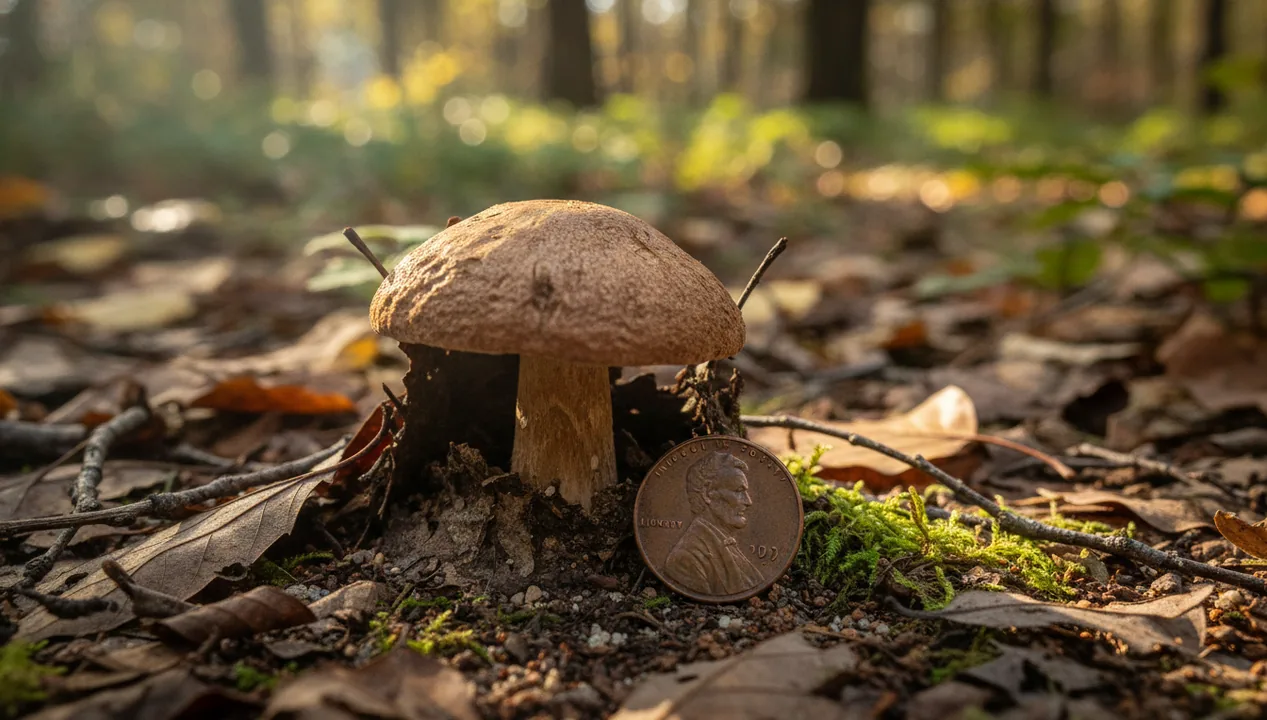
The mushroom features a camera misses
A photo gets you a name to check. It does not get you a verdict. A mushroom cannot be identified reliably from a picture alone, and a photo-only result from an app is not proof of species or edibility. The photo needs company: where the mushroom grew, when, what it grew on, and how it smelled.
Names add a second problem. Common names can point to different species, and a mushroom that is edible in one region can have a poisonous lookalike in another. Distribution, season, age, weather and local species diversity all change the answer. A name from an app is not enough to eat on, and neither is a name from a webpage.
So treat every answer as a lead. Add your photo in the upload slot up top and you get a brief description, a likely name and how certain the AI is. Use that as the first line of a checklist, then work through the rest of this page to test it.
The photos every unknown mushroom needs
A single top-down image is usually not enough. The Hang Outdoors guide to mushroom lookalikes recommends shots from above, from the side and from underneath. Take all of them of the same specimen, ideally before you touch it.
- From above. This shows cap diameter, color, texture, scales, spots, bruising and the margin. Note whether the cap is convex, flat, depressed or funnel-shaped.
- From the side. This shows the stem, including its length, width and texture, plus any ring, bulb or sheath.
- From underneath. This shows whether the mushroom has true gills, pores, teeth or a smooth surface. It is the photo people skip most often.
- The base. Photograph it without disturbing it. A cup-like volva at the base can be diagnostically important, which is one more reason to document the base before you pick anything.
- The surroundings. Soil, wood, lawn, dung, a living tree, a dead tree or buried roots all count as habitat. Add a ruler or a coin for scale, but never lean on appearance alone.
If the mushroom sits on wood, photograph the trunk or stump too. Naming the host tree gives whoever checks your record one more clue.
What to write down next to the photos
Photos capture shape and color. They miss the rest. Jot these details down before you leave the spot, because you cannot recover them later from a picture.
| Detail | What to record |
|---|---|
| Gills | How they attach to the stem, how close together they are, how thick, whether they branch, and any color change |
| Stem | Whether it is hollow or solid, plus ring, bulb, sheath and bruising |
| Spore print | The color, which can separate visually similar species |
| Growth pattern | Solitary, scattered, clustered or in a ring |
| Place and time | Location, date, elevation and season |
| Senses | Odor, and whether the flesh bruises |
| Neighbors | Nearby plants, which a flower identifier can help you name if you are stuck |
The spore print deserves a second look. It is one of the few checks that separates species that look the same on the surface. Make one if a reliable guide recommends it for the mushroom in front of you.
Mushroom lookalikes that fool people
Some pairs are famous because the mistake is easy. The Hang Outdoors guide covers two that are worth memorizing, and the others in this table are the general cases to keep in mind.
| Pair | What separates them |
|---|---|
| Chanterelle and jack-o'-lantern mushroom | Chanterelles have blunt, forked ridges and usually grow from soil. Jack-o'-lantern mushrooms have sharp true gills and commonly grow in clusters on wood or buried roots. |
| Honey mushroom and deadly galerina | Honey mushrooms leave a white spore print. Deadly galerina leaves a rusty-brown print and is generally smaller with a smooth cap. |
| Edible mushroom and poisonous Amanita | A generic photo cannot settle it. Check the complete stem base, ring, cap features, spore print and habitat, then get a local expert to confirm. |
| Any edible species and a regional lookalike | Distribution, season, age, weather and local species diversity can change the identification. An app's name is not enough for eating. |
Look at what actually separates the first two pairs. Ridges versus gills only shows from underneath. A spore print is a color on paper. Neither one appears in a top-down shot. That is the whole argument for taking the extra photos and doing the extra step.
Steps to take today with a mushroom you cannot name
If you found one in your yard or on a trail and want an answer, work through this list in order.
- Do not taste or eat it, and keep children and pets away from it.
- Photograph it in place from above, from the side and from underneath.
- Photograph the stem base and the surrounding habitat before you move anything.
- Put a ruler, coin or another familiar object beside it for scale.
- Write down the location, date, habitat, growth pattern, odor and any bruising.
- Collect it only where that is legally permitted. Keep the entire specimen intact and separate from other mushrooms.
- Make a spore print if a reliable guide recommends one.
- Upload the complete record to iNaturalist or Mushroom Observer.
- Compare the leading suggestions with a regional field guide and at least one specialist source.
- Get confirmation from a qualified local expert before any consumption.
Steps 1 to 5 take about as long as a coffee. The rest is where an honest identification happens.
Free ways to get a name: apps, databases and field guides
Typing what mushroom is this into a search bar turns up apps, forums and databases. They are not interchangeable, and each does a different job.
- The checker on this page. It reads your photo and reports how certain the AI is of its answer. Take the answer as a hint and keep going with the checklist above.
- iNaturalist. You upload an observation and get computer-generated suggestions plus community identification. Quality depends on your photographs and supporting details.
- Seek. It provides on-device nature identification and was listed as free in a 2026 comparison on Forager IQ.
- Mushroom Observer. It is built for fungi. It supports higher-resolution images, taxonomic synonyms and specialized fungal searches, and its users are mycologically minded.
- MushroomExpert.com. This is a reference site with identification information and keys, useful for checking a suggestion rather than generating one.
- Regional field guides. They cover distribution, seasonal occurrence, diagnostic features and the lookalikes that live near you.
There is no single best mushroom identifier. AI mushroom apps can suggest species, lookalikes, confidence levels and safety notes, but no app makes a mushroom safe to eat. The strongest setup pairs one fast suggestion with a community check and a regional guide.
If the thing in the grass is not a fungus at all, asking what an object is called may get you further, the fish page suits a catch from a nearby stream, and the homepage covers naming things from a photo in general. A stray cat curled up nearby is covered by the cat breed page, the unknown animal page handles any other creature, and the bug bite page applies if something bit you while you searched.
Safety: when a mushroom stops being an ID question
Looking at, photographing and handling mushrooms is not the danger, according to the Hang Outdoors guide. Eating is. Never eat a wild mushroom based only on a photograph, a webpage, an app or a single feature.
The numbers explain the caution. A CDC report counted 1,328 emergency-department visits and 100 hospitalizations in the United States in 2016 tied to accidental ingestion of poisonous mushrooms. In one insurance-claims dataset covering 2016 to 2018, 48 of 556 patients, or 8.6%, had a serious adverse outcome. The CDC's conclusion, published in 2021, was that wild mushrooms should not be eaten unless an expert identifies them.
These are the warning signs that you are about to make a mistake.
- It looks just like a mushroom you already know.
- You are relying on one feature, such as the cap color.
- You only have one photo, or no photo of the underside or base.
- An app gave a high confidence score and you are treating it as confirmation.
- A name you found says edible, but you do not know if that holds in your region.
If anyone has already eaten a mushroom, contact local poison control or emergency services right away. Do not wait for symptoms, and do not wait for an app to name it. If you plan to eat any wild mushroom, get that exact specimen confirmed by a qualified local expert, such as a mycological society or a university extension service.
Privacy and collecting rules before you post a mushroom photo
Location-tagged observations can reveal private residences, rare-species locations and valuable foraging sites. Turn off precise coordinates or use the geoprivacy controls on the platform you post to. The exact settings differ from one platform to the next, so check before you upload.
Collecting rules are local too. Whether you may pick fungi depends on the country, the landowner, protected-area rules and local regulations. Photographing a mushroom in place is allowed almost anywhere, which is another reason to start there.
Photo habits that make a mushroom shot useless
Most failed identifications come from a short list of habits.
- Using one photograph, usually from above.
- Leaving out the underside or the stem base.
- Picking the mushroom before documenting its habitat and growth substrate.
- Skipping size, date and location.
- Mixing several specimens in one container.
- Ignoring spore-print color.
- Confusing true gills with blunt ridges.
- Relying on common names, which can refer to different species.
- Assuming a mushroom that is edible in one region is edible everywhere.
The last mistakes are the dangerous ones, and they are about decisions, not photos. Treating a confidence score as confirmation, eating a specimen because it resembles a familiar one, and waiting for symptoms before calling poison control after ingestion can all turn a harmless curiosity into an emergency. Answering what mushroom is this is a fun puzzle. Keep it a puzzle until a local expert has seen the real thing.
Questions about what mushroom is this
What mushroom is this free?
Free options exist for a first guess. Seek provides on-device nature identification and was listed as free in a 2026 comparison on Forager IQ. iNaturalist and Mushroom Observer let you post photos for community identification. Free or paid, the result is a lead to check against a field guide, never permission to eat the mushroom.
What kind of mushroom is this AI?
AI mushroom apps look at your photo and suggest a species, possible lookalikes, a confidence level and sometimes safety notes. None of them makes a mushroom safe to eat, and a high confidence score is not confirmation. Results depend on your photos, so include the top, side, underside and stem base.
Can a photo alone identify a mushroom?
Yes, a picture can produce a useful suggestion, but not a reliable identification on its own. Take photos from above, the side and underneath, add the stem base and the habitat, and record location, date and odor. Then compare the suggestion with a regional field guide and a local expert.
What is the best mushroom identifier app?
No single app wins. iNaturalist gives computer-generated suggestions plus community identification, Mushroom Observer is specialized for fungi, and Seek is free and works on the device. A sensible approach is to take one suggestion, compare it with a regional field guide and at least one specialist source, then ask a qualified local expert.
Is it safe to touch a mushroom to photograph it?
According to the Hang Outdoors guide, looking at, photographing and handling mushrooms is not the danger. Ingestion is the critical risk. Still, photograph the mushroom in place first, keep the whole specimen intact if you collect it, and only collect where it is legally permitted.
What is a spore print and why does it matter?
A spore print records the color of a mushroom's spores. It can separate visually similar species. Honey mushrooms leave a white print, while deadly galerina leaves a rusty-brown one, and the two can be confused. Make a print if a reliable guide recommends it for your mushroom, and write the color down.
Why do I need photos of the underside and stem base?
The underside shows whether a mushroom has true gills, pores, teeth or a smooth surface, which separates lookalikes such as chanterelles and jack-o'-lantern mushrooms. The base can carry a cup-like volva that matters for identification. The Hang Outdoors guide says a single top-down image is usually insufficient.
What should I do if my child or pet ate a wild mushroom?
Contact local poison control or emergency services immediately. Do not wait for an app to identify the mushroom, and do not wait for symptoms to appear, since waiting is a listed common mistake. Serious outcomes can follow accidental ingestion, which is why speed matters more than finding the species name.