
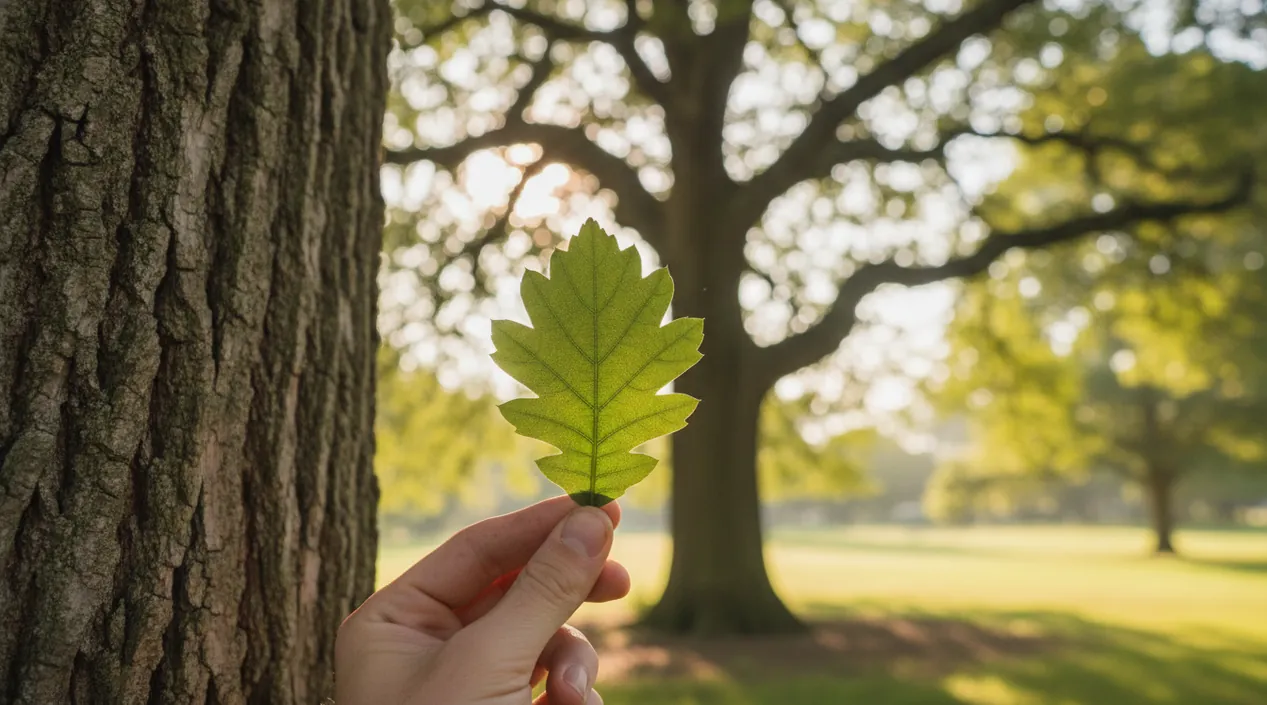
Why one leaf is a weak clue
A leaf is the first thing most people photograph, and it is a fair place to start. It is also easy to misread. Closely related trees often share overlapping leaf traits, so a leaf-only answer can stall at the genus or family level. That point shows up in both Woodland Trust and NC State Extension guidance. Season matters too. A leaf in May does not look like one in October, and a young sapling can carry leaves its parent never grows.
So treat the leaf as the opening move, not the verdict. The features worth collecting are leaf or needle type, how leaves attach, whether the leaf is simple or compound, then its shape, edge and veins. After that come buds, bark, fruit and the overall shape of the tree. Add where you are and what time of year it is. Those last two cut down the list of candidates before you look at a single leaf, which is why any good tree identifier by leaf asks for a location.
Photographing a tree so it can be identified
Most failed identifications are photo problems, not tree problems. A blurry, backlit or color-shifted shot hides exactly the details you need. A distant shot of the canopy shows almost nothing. Work through this list and you will have what a forester, an extension agent or an app would ask for.
- Photograph the entire tree from a distance.
- Photograph one leaf or needle cluster from above.
- Photograph the underside of that leaf.
- Photograph where the leaf attaches to the twig.
- Note whether leaves sit opposite each other or alternate along the twig.
- Note whether the leaf is simple or compound.
- Note the edge as smooth, toothed or lobed.
- Photograph the bark, plus any buds, fruit, cones or nuts.
- Write down the country, state or province, city, habitat, date and season.
Steps one to four take about a minute. They are also the steps people skip, then regret when two possible species differ only on the underside of the leaf or at the twig. For a quick first suggestion, drop the leaf and whole-tree shots into the upload form on this page. The AI studies the leaf or bark in your picture and names a probable species with how firm its answer is, a lead to check rather than a ruling.
Opposite or alternate leaves, simple or compound
These two checks do more work than any other, and they are easy to get wrong. The Virginia Department of Forestry explains both clearly.
Opposite leaves versus alternate leaves
Look at a node, the spot where a leaf joins the twig. Opposite leaves come in pairs, one on each side at the same node. Alternate leaves grow singly in a staggered pattern, one here, the next a bit further along on the other side. Maples and ashes are both opposite-leaved, so this check helps you separate them from many other trees but not from each other. Check the actual node, not the overall leaf shape.
Simple leaf versus compound leaf
A simple leaf has one blade. A compound leaf has several leaflets attached to a central stalk called a rachis. The classic mistake is photographing one leaflet and calling it a whole leaf. To avoid it, follow the stalk back to the twig. If you find a bud where the stalk meets the twig, you have found the true base of the leaf, and everything hanging off the stalk is leaflets. A single leaflet photographed alone sends every identifier down the wrong path.
Leaf margins, shapes and veins
Once you know the arrangement and structure, look closely at the blade itself.
The edge, called the margin, is smooth, toothed or lobed. Cornell Small Farms and the Woodland Trust both list margin as a standard feature. Shape falls into broad categories, and NC State Extension names needle-like, scale-like, oval, heart-shaped and lobed among the common ones. Do not overthink the category. Pick the one that fits best and move on.
Veins are the third detail. Pinnate veins run off one main central vein, like the barbs on a feather. Palmate veins fan out from the base of the leaf as several major veins, like fingers from a palm. Turn the leaf over and look at the underside, because veins show best there. This is also where you will notice differences in texture and color between the two sides.
A leaf-based key works by asking exactly these questions in order. Simple or compound, opposite or alternate, smooth, toothed or lobed. Each answer removes a chunk of possible species. That is the logic behind an interactive tree key, and you can run it by hand with nothing but your photos.
What buds and twigs tell you in winter
No leaves does not mean no answer. The Woodland Trust and the Virginia Department of Forestry both point to buds and twigs as useful features, especially in winter. Bud shape, the number and arrangement of bud scales, bud size and the way twigs branch can all separate species when the canopy is bare.
Take a close photo of a twig with a coin or your fingertip beside it for scale. Photograph a few buds from the side. Note whether buds sit opposite each other or alternate, since that is the same opposite versus alternate test you would use on leaves. Add a photo of the bark and the shape of the whole bare tree. Winter is slower work, but a bare twig holds more information than people expect.
Bark, fruit, cones, nuts and whole-tree form
Bark, fruit and cones are best used as confirmation. The Virginia Department of Forestry recommends photographing them whenever they are present. A leaf suggestion that matches the fruit and the bark is far stronger than a leaf suggestion standing alone. If a seed, nut or cone is lying under the tree, photograph it where it lies, then step back and show that it really sits beneath the tree you are asking about.
Tree form covers crown shape, branching pattern, number of trunks and height. These details help narrow things down, though they are usually less decisive than leaves, buds or fruit. A tree grown in open space spreads wide, and the same species in a crowded woodland grows tall and narrow. Use form to rule things out, and do not use it as proof.
Broadleaf trees versus conifers
The first split is quick. According to the Woodland Trust, broadleaf trees usually have flat leaves, while conifers generally have needles or scales. If your tree has needles, photograph a cluster and how the needles attach to the twig. If it has scale-like foliage, photograph a small branch from two angles. Cones, when you can find them, are the best companion shot for a conifer, since they differ a lot between species, much as naming a fish species relies on one telling feature.
Look-alike trees that trip people up
Some pairs fool nearly everyone. The table below collects the ones named in the sources and the check that separates them.
| Easily confused | What to check | Source |
|---|---|---|
| Red maple and sugar maple | Red maple leaves have toothed margins. Sugar maple leaves generally do not. | Cornell Small Farms |
| Maples, ashes and other opposite-leaved trees | Check the actual node arrangement, not the overall leaf shape. | Virginia Department of Forestry, Cornell Small Farms |
| Elm species | Look for unequal leaf bases. | Woodland Trust |
| Broadleaf trees and conifers | Flat leaves point to broadleaf. Needles or scales point to a conifer. | Woodland Trust |
The pattern is worth noticing. Each pair has a single check that does the real work, and none of those checks is overall leaf shape. If two candidates look alike in your photos, go find that one extra feature rather than staring harder at the same leaf.
Using a tree identifier by leaf, apps and databases
Photo tools are fast and often right, but each one is a suggestion engine. Here is what the sources say about the main options.
- iNaturalist. Community identification for plants and animals, with a large database and user base. The i-Tree Tools list and the North Carolina Tree Farm Program both include it.
- Seek by iNaturalist. A free mobile identification app listed among tree tools by i-Tree.
- PlantNet. Photo-based plant identification through mobile apps. The LSU AgCenter lists it as a free Android and iOS tool and describes it as a plant-identification network organized by country.
- LeafSnap. Uses visual-recognition software to identify tree species from photographs. The LSU AgCenter listing describes it as free.
- PictureThis and PlantSnap. Commercial mobile apps that i-Tree lists among tree-identification tools.
- USDA PLANTS Database. A plant database listed among identification resources, most relevant in the United States.
- Interactive tree keys. Stepwise tools that walk you through observable features.
Pair two tools, not one. A sensible combination is PlantNet plus iNaturalist, since they work differently, and one is built around a community of people reviewing observations. Then compare the suggested species with a regional guide from your state forestry agency or extension service. Regional matters. A guide written for the wrong part of the world will list trees that do not grow near you and miss the ones that do.
On cost, the LSU AgCenter page lists a MyNature Tree Guide that identifies more than 190 trees by leaf or needle characteristics, priced at $6.99 at the time of that listing. It also lists a northeastern-U.S. guide at $3.99 and another plant guide as free with a $2 fee for some functions. Listings change prices and features often, so look at the current store page before paying for any app.
If your question is wider than trees, the same photo habits apply to other plants. The same logic of several features, not one, runs through flower identification and figuring out an unknown mushroom. For anything else on your phone that you cannot name, the homepage is the place to start with a photo.
Checking three features before you accept an answer
Here is a rule that saves a lot of embarrassment. Accept an identification only when at least three independent features agree. For example, arrangement, margin and fruit. Or needle type, cone and bark. If an app says sugar maple, ask whether the leaf edges, the opposite arrangement and the seeds all fit. If two tools disagree, do not pick the one that sounds most confident. Report the tree as unknown for now, or name only the genus or family that the evidence supports.
That last part is honest and useful. Saying this is a maple but you are not sure which one is a better answer than a wrong species name that spreads from a forum post to a garden label. Cultivated varieties, hybrids and planted ornamentals also blur the picture, and a common name can refer to more than one species. If the label on a nursery tag and your app disagree, treat both as clues.
Privacy settings to check before you upload a tree photo
Photos sent to community apps can carry location data. Before you upload, review the geotagging, public-observation, account and image-licensing settings in the app. Policies and data retention differ by service, so read the one for the specific app you use. Keep people, house numbers, license plates and private property out of the frame. A tree in a neighbor's yard is still on private property, and a clear shot of the house behind it can reveal more than you intended.
Common tree identification mistakes
Most wrong answers trace back to a few habits.
- Identifying from one leaf without noting location or season.
- Mistaking a leaflet for a complete leaf.
- Skipping the opposite versus alternate check.
- Ignoring bark, buds, fruit or cones.
- Photographing only a distant canopy.
- Using a blurry, backlit or color-distorted image.
- Trusting an app's top result as proof.
- Forgetting about hybrids, cultivated varieties, juvenile leaves and seasonal change.
- Using a guide from the wrong region.
- Assuming a common name means one species.
- Confusing a shrub, vine or planted ornamental with a tree.
- Naming a species when all you can show is a genus or family.
Safety around trees you cannot name yet
No photo match is reason enough to eat, handle or treat any part of a tree. Do not eat leaves, berries, nuts, seeds, sap or bark based on an app result. Do not touch sap, thorns, irritating hairs or unknown plant material without protection, and if you get a rash or bite while poking around, our guide to identifying bug bites by picture can help you spot the likely culprit. When a child or pet chews on any part of an unidentified tree, phone poison control or a doctor immediately and bring a sample or photo. For trees that may be toxic, invasive, protected or legally significant, ask an arborist, botanist, forester or extension agent. Also get permission before you climb, cut, dig up or collect from any tree. Rules for protected trees and collecting on public land vary by place.
Where to take a tree that stays unidentified
When your photos, two tools and a regional guide still do not agree, take the question to a person. State forestry agencies and extension services provide regional guides, field keys and expert help, though what is available varies by location. Bring your whole-tree photo, leaf top and underside, twig, bark, any fruit, and your notes on location, habitat, date and season. That package is exactly what the experts want. If you are still deciding what kind of thing is in front of you, naming an object you cannot describe helps. Spotting the animal in your tree photos covers the creature in the branches. A cat there points to the cat breed page, and a dog to the dog breed page.
Questions about what type of tree is this
How can you tell what type of tree it is?
Compare several features, not just the leaf. Check whether the tree has leaves or needles, whether leaves are opposite or alternate, simple or compound, and whether the edge is smooth, toothed or lobed. Then look at bark, buds, twigs, fruit or cones, and note your location and season. The Woodland Trust says more visible features generally make identification more reliable.
What are some good apps for identifying trees?
Sources list iNaturalist, Seek by iNaturalist, PlantNet, LeafSnap, PictureThis and PlantSnap. The LSU AgCenter describes LeafSnap as free and PlantNet as a free Android and iOS tool. Use two apps rather than one, then check the suggestion against a regional forestry or extension guide, since an app's top result is a suggestion, not proof.
What is the difference between opposite and alternate leaves?
Opposite leaves grow in pairs at a node, one on each side of the twig. Alternate leaves grow singly in a staggered pattern along the twig. The Virginia Department of Forestry uses this as a core identification check. Maples and ashes are both opposite-leaved, so check the actual node rather than the overall leaf shape.
Can you identify a tree from just a leaf?
Sometimes, but it is risky. Closely related trees often share overlapping leaf traits, so a leaf-only answer may only reach the genus or family. Photograph the top and underside of the leaf, where it attaches to the twig, and the bark, buds, fruit or cones. Add your location and season to make the answer stronger.
How do you tell a broadleaf tree from a conifer?
The Woodland Trust says broadleaf trees usually have flat leaves, while conifers generally have needles or scales. If you see needles, photograph a cluster and how they attach to the twig. If you can find cones, photograph those too, because they are a useful extra clue for confirming a conifer.
What are the main types of trees?
The first split is between broadleaf trees, which usually have flat leaves and often drop them in fall, and conifers, which generally carry needles or scales and produce cones. From there, leaf arrangement (opposite or alternate), simple versus compound leaves, bark texture and fruit narrow a tree down to a family and then a species. That is also the order to check them in when you photograph a tree.
What should I do when two tree identification apps disagree?
Do not choose the result that looks most confident. Compare each suggestion against at least three independent features, such as leaf arrangement, margin and fruit. If they still disagree, report the tree as unknown, or name only the genus or family your evidence supports, and ask a local expert such as an extension agent or arborist.
Which trees are most often confused?
Red maple and sugar maple, maples and ashes, and the different elm species confuse people most, because their leaves look alike at a glance. Check leaf arrangement first: maples and ashes have opposite leaves, while elms have alternate ones. Then compare the leaf edge, the number of leaflets on compound leaves and the seeds to settle it.
Sources
- Woodland Trust, how to identify trees
- i-Tree Tools, tree identification tools
- North Carolina Tree Farm, tree identification apps
- Virginia Department of Forestry, tree identification
- Woodlands.co.uk, tree identification
- Cornell Small Farms, features of trees useful for identification
- NC State Extension, identification of common trees of North Carolina
- LSU AgCenter, tree identification apps and guides