
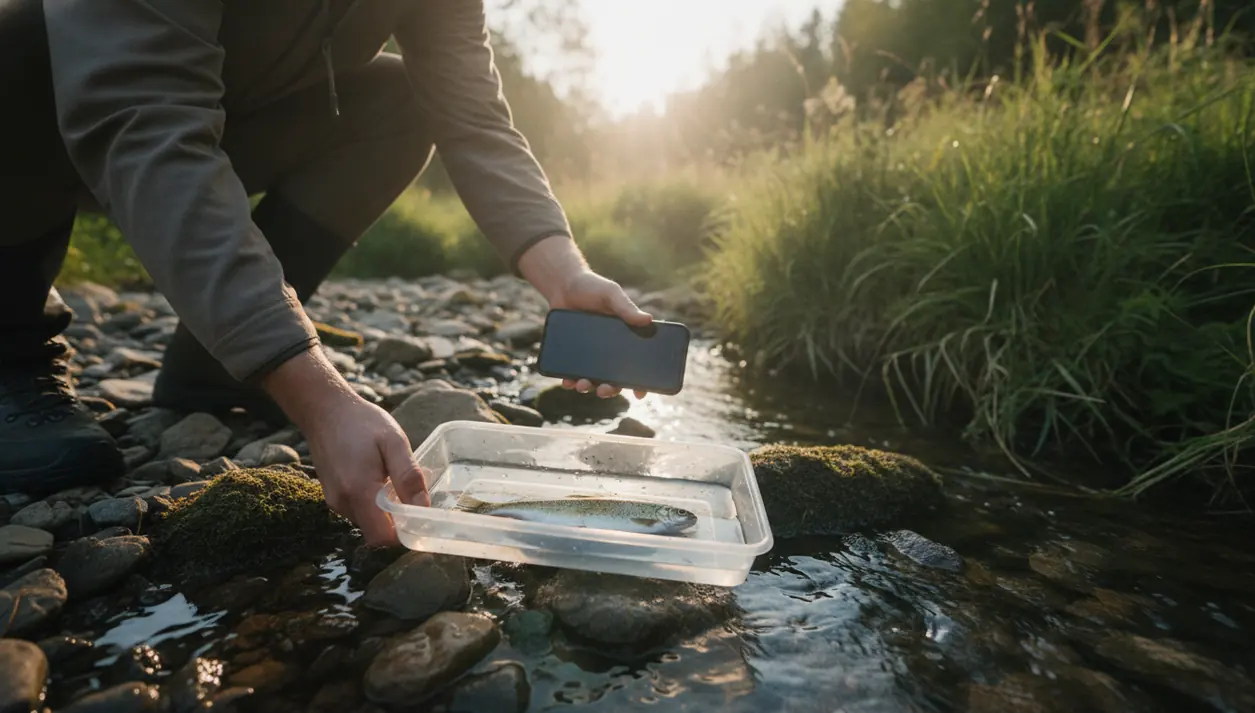
The three photos that make a fish identifiable
Most failed fish identifications start with a bad photo, not a hard fish. A photo guide on fish-identifier.org recommends three shots: a sharp full side view, a close-up of the head and mouth, and a view of the fins or tail. Take all three if the fish holds still long enough.
Keep the whole fish in frame from nose to tail. A crop that cuts off the tail or hides a dorsal fin removes the exact features that separate lookalikes. Watch for glare on wet scales, folded fins, and a camera angle that stretches the body. A fish shot from above with a wide lens looks fatter and shorter than it is.
Write down a few things while you are there. The date, the place, the habitat, whether the water is fresh or salt, and a rough length. That context often decides between two fish that look identical in a photo.
Which features on a fish tell species apart
Work through the fish from the outside in. Use the table to see which features to check and which differences count.
| Feature | What to look at |
|---|---|
| Body shape | Elongated, deep-bodied, flattened, cylindrical, eel-like or disc-shaped |
| Mouth | Terminal, upturned, downturned, protruding, beak-like, or reaching back past the eye |
| Fins | Position, shape, number of dorsal fins, spines, and whether fins are joined |
| Tail | Forked, deeply forked, rounded, square or lunate |
| Markings | Stripes, bars, spots, eye-like spots, lateral-line pattern, fin markings |
| Scales and skin | Visible scales, armor plates, barbels or whiskers, spines, smooth skin |
| Context | Fresh or salt water, region, depth, bottom type, season, and whether the fish was caught, in an aquarium or stranded |
The mouth is the feature people skip, and it is one of the most useful. An upturned mouth suggests a fish that feeds near the surface. A downturned one points to a bottom feeder. That alone can rule out half your candidates.
Why color is the weakest clue
Color feels like the obvious thing to match, and it fails more often than anything else. Fish identification guides from fish-identifier.org and fishcareai.com both warn that color shifts with age, sex, water conditions, lighting and stress. A fish that has been out of the water for a while also fades, so a dead fish rarely shows its live colors.
So when two fish share a color, compare the structure instead. Look at body proportions, mouth position, fin arrangement and where markings start and stop. For stripes or spots, ask three questions. Do they reach the fins? Do they continue across the lateral line? Is that spot a true eye-like spot or just a dark patch? When the photo is sharp enough, count the dorsal spines and rays. Lookalikes often differ right there.
From photo to species name, step by step
This is the order that keeps you from jumping to the first match.
- Keep the original, uncropped photo and note the date, location, habitat, water type and approximate length.
- Check the image for glare, distortion, folded fins and color changes from a fish that is no longer alive.
- Describe the fish in your own words. Body shape, mouth, tail, dorsal fins, markings, scales and any odd structures.
- Upload the photo to a reputable identification service such as iNaturalist or a fish database.
- Collect several candidate species instead of accepting the first one.
- Compare each candidate with the range, habitat, body proportions, mouth, fins, tail and markings.
- Find the one feature that separates the two closest candidates, and get a clearer photo of it if you can.
- Check the finalist in FishBase and in a regional museum, university, government or field-guide source.
- If the deciding feature is not visible, call it "likely" plus the species name, or leave it open.
Step nine feels unsatisfying, but it is honest. A hedged answer you can improve beats a confident wrong one that ends up in a record or a decision.
What FishBase and iNaturalist give you
FishBase is the biggest free reference to check against. Its home page, updated October 26, 2026, lists 36,761 fish species in 5,276 genera, 629 families, 84 orders and 10 classes. It also lists more than 66,300 pictures, 333,268 common names, and 1,687 identification keys that cover 8,226 species. Species pages include distribution, morphology, photographs and references. FishBase also has a picture-based search for species records.
The species total moves. FishBase's classification page lists 36,761 species today, but taxonomists revise classifications, so expect the number to change.
iNaturalist works differently. You upload an observation and get suggestions from the community or from machine learning. You control the location privacy of each observation, and iNaturalist states that it does not sell users' personal information. A fish with a clear photo and a location often gets a community answer from someone who knows the local water.
Regional field guides add what global databases can blur, namely which species actually live where you are standing. For tough cases, or for any fish that might be protected or commercially regulated, museums, universities, aquariums and fisheries agencies can verify an identification.
One catch with names. One common name can cover several species, and a single species may go by many names. If you only have a nickname for a fish, our page on finding the right name for something covers the same problem for objects. For fish, the scientific name is what settles it.
Lookalike traps that fool people
- Young versus adult. Juveniles can have different colors and proportions from adults. Size alone does not tell you the stage.
- Fresh water versus salt water. Confirm the location and salinity before you narrow the candidates. It removes whole families at once.
- Fish versus shark, ray, eel or amphibian. Check the gill-cover structure, the paired fins, how the body tapers, and where the dorsal and anal fins sit.
- Different dorsal fins. Two fish with similar bodies can differ in how many dorsal fins they have, or in their spine and ray counts.
- Common name equals one species. It almost never does.
Size deserves its own warning. Camera perspective, age, sex and growing conditions all change how big a fish looks or is. A ruler in the shot, placed safely beside the fish, beats a guess. If you are not even sure the creature is a fish, the animal identification page is a better first stop.
Photographing the whole subject plus its surroundings is a habit that carries over to other nature finds on the same trip, such as a flower you cannot name, an unfamiliar tree, or a mushroom growing by the water.
Using an AI fish identifier without being fooled
A fish identifier app or AI tool can generate candidate species from a photo. That is useful, and it is also where people go wrong. A suggested match is not proof. Treat it as a shortlist and verify it against body shape, mouth, fins, range, habitat and an authoritative reference.
Our own scanner works this way. Put the photo in the photo field at the head of the page and the AI returns a brief description and how reliable it thinks the answer is, which gives you a lead to check against FishBase. The answer is a suggestion. Other things can be named from a single photo too, such as a dog's breed or mix or a cat's breed or coat type, and the homepage covers the general method.
The common mistakes are predictable. Relying on color alone. Using a cropped photo. Ignoring range. Treating an AI suggestion as confirmed. Failing to count fin spines or look at the mouth. Comparing your fish only with photos taken in different lighting. If you avoid those six, you are ahead of most guesses online.
Safety, legal and privacy points before you act on an ID
An unknown fish can hurt you, and if you come home with a mark you cannot explain, our guide to identifying bug bites can help you rule out an insect. Do not handle it with bare hands, because spines, teeth, venom, electric organs and bites can all cause injury. Do not eat a fish you cannot identify. Species-specific toxins, parasites, contamination and local consumption advisories can apply.
Do not base legal decisions on a shaky identification either. Fishing seasons, minimum sizes, bag limits, protected-species rules and release requirements vary by jurisdiction, so check the rules for your location and year with the local fisheries authority. Avoid moving live fish between waterways, since that can spread invasive species and disease.
Privacy matters on the photo side. Remove or blur faces, vehicle plates, home addresses and private-property details before you upload. Location data can reveal private property, rare-species sites, nests or favorite fishing spots, so use the per-observation location controls on iNaturalist. And never trespass or enter restricted water, docks, aquariums or protected areas to get a better shot.
Questions about what fish is this
Can AI identify fish?
AI can suggest candidate species from a photo, and iNaturalist offers community or machine-learning suggestions for uploaded observations. A suggestion is not proof, though. Check it against body shape, mouth position, fins, tail, range and habitat, then confirm it in FishBase or a regional field guide. A sharp full side view plus the location gives any tool the best chance.
Can I identify a fish by its fins and markings?
Yes, fins and markings are some of the most useful clues. Note the number and shape of the dorsal fins, the tail shape, where the mouth sits and any spots, bars or stripes. Photograph the whole fish from the side on a flat surface, then compare it with a regional fish guide or your state wildlife agency, because common names change from place to place.
How do I confirm a fish identification?
Treat any suggestion as a shortlist, not proof. Collect several candidate species, then compare each with the range, habitat, body proportions, mouth, fins, tail and markings. Find the one feature that separates the two closest candidates, then check the finalist in FishBase and a regional field guide. If the deciding feature is not visible, call it likely plus the species name.
Can I identify a fish by its common name?
Not reliably, because fish carry a huge number of common names. FishBase lists 333,268 common names for 36,761 species. A common name can cover several species, and one species can have many common names, so a name alone almost never settles an identification. Search FishBase by common name, then confirm the scientific name against range, habitat, mouth, fins and tail.
How do I identify a fish from a photo?
Start with a sharp full side view, a head and mouth close-up, and a fin or tail view. Note where you found the fish and whether the water was fresh or salt. Then compare body shape, mouth, fins, tail and markings with several candidate species in FishBase and a regional guide, rather than accepting the first match.
Can I identify a fish by its color?
Color helps, but it is the least reliable clue. It changes with age, sex, water conditions, lighting and stress, and a dead fish rarely keeps its live colors. Compare body shape, mouth position, fin arrangement and where markings begin and end. Those features stay more consistent than color does.
Is it safe to eat a fish I cannot identify?
No. Do not eat an unidentified fish. Species-specific toxins, parasites, contamination and local consumption advisories may apply, and a photo-based guess is not enough to judge any of them. The same goes for deciding whether a fish is venomous, protected or legal to keep. Ask a local fisheries authority or a qualified expert.
What should I do if I cannot tell two similar fish apart?
Find the single feature that separates the two closest candidates, such as the dorsal spine count, the mouth position or whether markings cross the lateral line. Then get a clearer photo of that feature. If it is still not visible, report the fish as "likely" one species instead of stating it as fact, or ask a museum or fisheries expert.